THE NEW PHILADELPHIA SKYLINE
An informal understanding, dating back to the 1950s, restricted the height of new buildings in Philadelphia so as not to overshadow the 491 foot tower of City Hall (on which stands the statue of William Penn). However, an office building boom in the 1980s led to approval for a number of new towers and the rule was eventually removed.
One and Two Commerce Square
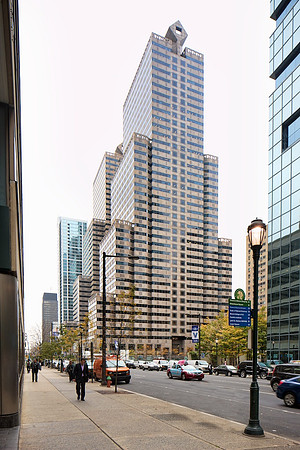
Commerce Square consists of One and Two Commerce Square, two identical 41 story office towers 565 ft. (172 m.) high that surround a paved courtyard of 30,000 square feet (2,800 m2). The complex covers an entire block and was designed by Henry N. Cobb and Douglas Gardner of IM Pei & Partners (now Pei Cobb Freed & Partners). Construction of the first phase, which included One Commerce Square, the plaza, and retail space, began in 1985 and was completed in 1987. The project's second phase, Two Commerce Square, did not begin until 1990 and ended Philadelphia’s skyscraper construction boom of the 1980s when it was completed in 1992. No other office skyscraper was built in Philadelphia until 2005.
The granite-clad towers feature setbacks on the north and south sides and are topped with a pair of stone diamonds with cutout squares in the center. Reaction has been mixed and Commerce Square was praised mainly for its design of two towers surrounding a plaza. The Philadelphia critic Edmund Bacon praised Commerce Square and its plaza by saying it "will prove to be one of the finest commercial projects to be built in this century" and New York Times architecture critic Paul Goldberg described Commerce Square as "discreet" and the standing diamond shapes on top as "strange".